
Difficulty, Hashrate and the Numbers Behind Daily Revenue
Daily revenue is one division and three multiplications. A difficulty of 132.76 T implies a network hashrate of 950.3 EH/s, the chain mints 450 BTC a day across 144 blocks, and at $85,294 per BTC that issuance is worth about $38,382,300. Your share of it is your hashrate divided by the network figure, so 1 PH/s produces 0.00047353 BTC a day, which is $40.39 gross and $38.77 after the listed 4% charge on the block reward.

Key takeaways
- Difficulty of 132.76 T implies 950.3 EH/s of network hashrate, and an independent 3-day average of 942.8 EH/s sits about 0.8% below it.
- The network pays 450 BTC a day, worth roughly $38,382,300 at a BTC price of $85,294.
- 1 PH/s earns 0.00047353 BTC a day; 10 PH/s earns 0.00473529 BTC, or $403.89 gross and $387.74 after the listed 4%.
- The next difficulty adjustment is estimated at +1.90%, which trims roughly that much from a fixed hashrate's daily Bitcoin.
The chain from difficulty to dollars
Start with difficulty, because it is the only input that comes from the chain itself. Difficulty of 132.76 T means a specific expected number of hashes per block, and dividing that work rate by the block interval produces an implied network hashrate of 950.3 EH/s. The block subsidy of 3.125 BTC paid 144 times a day gives 450 BTC of new coins to distribute, and the distribution is proportional to hashrate.
Three multiplications complete the chain. First, your hashrate divided by 950.3 EH/s gives your share. Second, multiply that share by 450 BTC and you have your daily Bitcoin. Third, multiply by the BTC price of $85,294 and you have dollars. Per TH/s the constant that comes out of this is 0.0000004735 BTC per day, which is about four cents, and the listed 4% charge on the block-reward component leaves $0.0388 per TH/s per day.
Which hashrate number to trust
There is more than one way to count the network, and they disagree at the margins. The figure implied by difficulty is 950.3 EH/s. A separate 3-day average of observed hashrate is 942.8 EH/s, about 0.8% lower. The gap is not a mistake in either number; difficulty is a measure of the work behind recent blocks and an average is a measure of the work arriving now, and hashrate that joined yesterday takes time to show up in both.
The practical rule is to use the difficulty-implied figure for forward estimates, because that is what the next blocks will be checked against, and to use the observed average as a sanity check. When the two diverge by more than a percent, treat a revenue estimate as a range rather than a single number. On a daily basis the difference between the two figures is about one part in a hundred and twenty, which at 1 PH/s is roughly $0.32 a day.
What moves the daily figure
Four inputs move, and they move on different clocks. Difficulty adjusts on the chain's own timetable; the BTC price moves continuously; your hashrate moves when machines or power change; and the listed fee moves only if the schedule changes. The table isolates the hashrate input at today's values.
| Hashrate | BTC per day | Gross USD per day | After the listed 4% |
|---|---|---|---|
| 300 TH/s | 0.00014206 | $12.12 | $11.63 |
| 1 PH/s | 0.00047353 | $40.39 | $38.77 |
| 10 PH/s | 0.00473529 | $403.89 | $387.74 |
| 100 PH/s | 0.04735289 | $4,038.92 | $3,877.36 |
Read the table as a scale, not a set of promises. Each row is ten times the one above it in hashrate, in Bitcoin and in dollars, and the ratio between gross and net never changes because the listed rate never changes. What does change with scale is the consequence of a mistake: a two-hour outage costs about $3.36 at 1 PH/s and about $33.60 at 10 PH/s, measured in gross income alone.
Downtime is the input most often left out of a revenue estimate, and it is the one an operator controls most directly. Two hours a week of planned maintenance at 1 PH/s removes about $175 a year of gross income at today's difficulty, which is more than a quarter's worth of the listed charge on the same hashrate. Multiplying the hourly figure of $1.68 by the hours your site is offline is the fastest way to see whether a maintenance schedule is cheap or expensive, and it needs no assumptions beyond the hashrate and the difficulty already on the page.
Worked example
Take 1 PH/s and derive the day from first principles, then check it against the shortcut.
- Difficulty is 132.76 T, which implies 950.3 EH/s of network hashrate.
- 1 PH/s is 0.000105% of that network, which is 1 PH/s divided by 950.3 EH/s.
- The network mints 450 BTC a day, so 0.000105% of it is 0.00047353 BTC.
- At $85,294 per BTC, that day is worth $40.39 gross.
- The listed 4% on the block-reward component takes $1.62, leaving $38.77 net.
- The shortcut gives the same answer: 1000 TH/s multiplied by 0.0000004735 BTC per TH/s per day equals 0.00047353 BTC.
- Across 30 days, 0.014206 BTC is mined for $1,211.68 gross and $1,163.21 net after a listed charge of $48.47.
- If difficulty takes its estimated +1.90% step, the same hashrate earns about 1.9% less, or $39.64 instead of $40.39 a day.
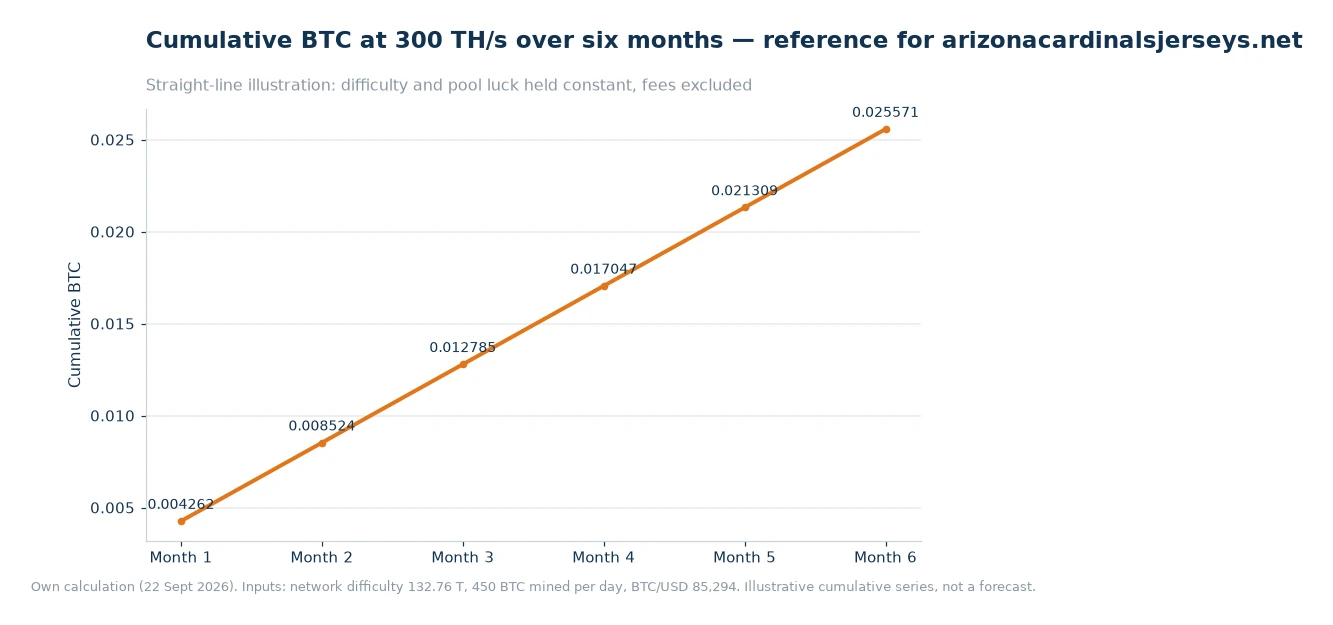
Reconciling that figure with a dashboard
Once the arithmetic is written down it becomes a test. Compare the daily figure you derived with the credited total on the ViaBTC Mining Statistics page, and the difference should be explainable by one of four inputs: a difficulty change you did not apply, a BTC price you did not refresh, hashrate below what you assumed, or an open settlement window. Anything else is worth a support ticket rather than a guess.
Two habits keep the derivation honest. Refresh difficulty daily from the Pool Hashrate page rather than from memory, because every dollar figure on your spreadsheet is scaled by it. And when the estimate drives a purchase or a hosting decision, run it through the Profit Calculator with an efficiency figure and a power price attached, since revenue without a cost line is only half the answer.
Frequently asked questions
Does difficulty affect the Bitcoin price?
No. Difficulty changes how many coins a given hashrate earns, not what those coins are worth in dollars, and the two effects move independently.
How much hashrate is needed for one Bitcoin a day?
About 2,112 PH/s at a difficulty of 132.76 T, which is the 950.3 EH/s network divided by the 450 BTC it mints each day, or roughly two thousand times a single petahash.
Why do two pools show different daily totals for the same machine?
Because of settlement windows and pool luck rather than hashrate: PPS+ credits hourly at current difficulty, while PPLNS settles after 6 confirmations over the last 5 difficulty rounds.
Rebuild the number each week
Daily revenue is not a fixed figure to remember; it is an output of four inputs that you can refresh in a few minutes. Write the difficulty, the network hashrate it implies, the price and your own hashrate on one line, then multiply. Keep last week's line next to it so a change is visible as a change rather than as a surprise, and note the estimated +1.90% adjustment so the direction of the next revision is already in the file. Done weekly, the estimate stays within a percent or two of reality, which is close enough for every operating decision except the largest ones.
Working figures: network difficulty 132.76 T, the 950.3 EH/s it implies, an independent three-day hashrate average of 942.8 EH/s, 3.125 BTC per block across 144 blocks a day and a BTC price of $85,294, all read 22 Sept 2026, with the fee columns taken from the client's listed schedule[1]. These are illustrations of the arithmetic and not a projection of returns, and they ignore power cost and hardware efficiency.